CCCTA Digital Transformation SOW — Critical Analysis
Client: Central Coast Chilcotin Tourism Association (CCCTA) SOW Value: $54,500 CAD | 4 Workstreams | Term: Through June 30, 2026 Prepared for: Ryan Monsurate & Gurinder Parmar Date: March 3, 2026
Executive Summary
This analysis stress-tests the CCCTA Phase 2 SOW from three angles: technical feasibility, strategic value alignment, and commercial integrity. It draws on 12 months of prior engagement context — from the April 2025 AI Kickoff through the December 2025 MPSA signing — plus ops interview data from Amy Thacker (CEO).
Key finding: The SOW is deliverable and commercially defensible, but has one significant technical blind spot (Asana template limitations) and would benefit from stronger scope boundaries. This is a contained, in-and-out engagement — not a multi-phase transformation arc.
Prior engagement timeline:
| Date | Milestone |
|---|---|
| Apr 2025 | AI Kickoff session |
| May–Jun 2025 | AI Governance Policy Discovery (2 sessions + interviews) |
| Jun 2025 | AI Governance Policy Draft V1 delivered |
| Aug 2025 | Ops Department deep-dive interview with Amy Thacker (CEO) |
| Oct 2025 | Innovation Workshop, Final Presentation, LOP approval |
| Dec 2025 | Master Professional Services Agreement signed |
Analysis Framework
Three lenses, scored 1–5:
| Dimension | Question | Score |
|---|---|---|
| Technical Feasibility | Can we deliver what's promised with the tools specified? | 3.5/5 |
| Value Alignment | Does this solve CCCTA's actual problems? | 3/5 |
| Commercial Integrity | Is pricing, structure, and scope honest and defensible? | 4/5 |
Per-workstream evaluation criteria:
- Deliverability — Can this be done within scope/budget?
- Impact — Does this move the needle for CCCTA?
- Sustainability — Can CCCTA maintain this independently after June 30?
- Honesty — Does the SOW promise what it can deliver, no more, no less?
Part 1: Technical Analysis — Workstream D (Asana, $22K)
What the SOW promises
- Configure Asana Advanced (10 seats) for CCCTA's core operational workflows
- Migrate 2–3 manual workflows as reusable templates (project templates, rules, task duplication)
- Brief handoff walkthrough
- Explicitly excludes: integrations, custom software, data migration, ongoing admin
Critical Asana platform limitations
| Issue | Severity | Impact on SOW |
|---|---|---|
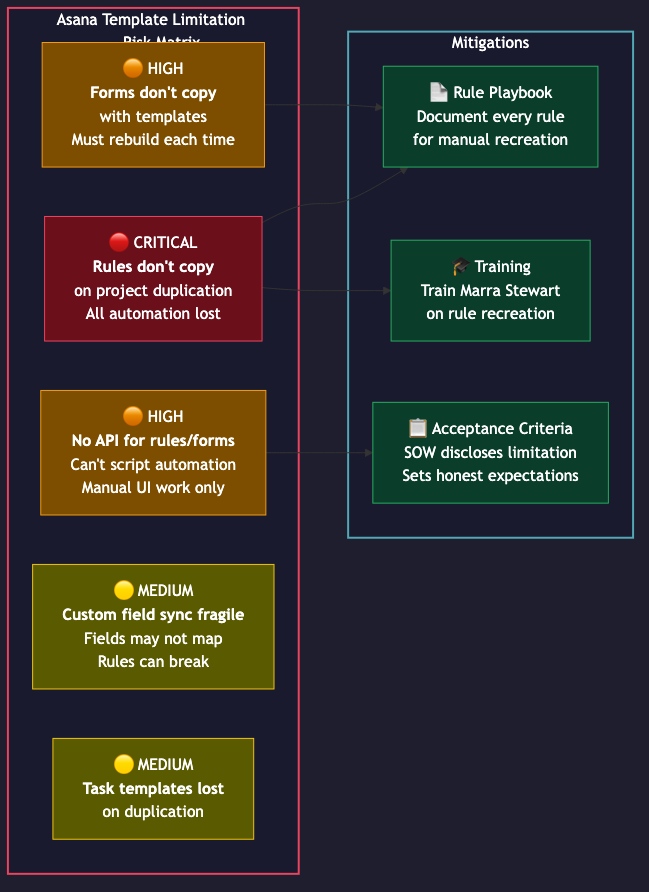
| Rules don't copy when duplicating projects/templates | CRITICAL | The "reusable template" promise is fundamentally compromised. When CCCTA duplicates the "Annual Fair" template next year, all automation rules vanish. They must manually recreate every rule. |
| Forms don't copy with templates | HIGH | Intake forms (e.g., vendor registration, session proposals) must be rebuilt in each new project instance. |
| No API for rules or forms | HIGH | Farpoint can't script or automate template creation. Everything is manual UI work. |
| Custom field sync is fragile | MEDIUM | Fields defined in templates may not properly map when projects are duplicated. Rules referencing those fields can break. |
| Task templates don't copy | MEDIUM | Reusable task templates within projects are lost on duplication. |
What we can actually deliver
The "reusable template" concept is misleading as written. What Farpoint can deliver:
- A reference project with tasks, sections, and custom fields that can be duplicated (structure copies)
- Rules that work in the original project but must be manually recreated in every duplicate
- A "rule playbook" — documentation of what rules to recreate
- Handoff that trains Marra Stewart on how to recreate rules
This is still valuable — but the SOW should be honest about the limitation rather than implying full template reusability.
Is $22K justified?
Implied effort breakdown (generous estimate):
| Activity | Hours |
|---|---|
| Requirements gathering (2–3 workflow discovery sessions) | 12–15 |
| Asana environment design (custom fields, project structure, portfolios) | 8–10 |
| Build 2–3 project templates with rules, sections, fields | 15–20 |
| Testing and refinement | 5–8 |
| Documentation (rule playbooks, user guides) | 8–10 |
| Handoff training (2–3 sessions) | 6–8 |
| Project management overhead | 5–8 |
| Total | ~60–80 |
At $22K / 70 hours = ~$314 CAD/hr. Market rate for Canadian Asana consulting is $100–200/hr. This is 1.5–3x market rate.
Defensible if: Framed as strategic workflow consulting (not just Asana setup), includes the discovery already done in Phase 1, and emphasizes custom design work. Less defensible if: the client sees it as "configure a SaaS tool."
Technical Verdict: 3/5
Feasible but the "reusable template" promise needs qualification. The rules-don't-copy limitation is a real delivery risk that could damage credibility if not disclosed upfront.
Part 2: Feasibility Assessment
| Workstream | Budget | Feasible? | Risk | Notes |
|---|---|---|---|---|
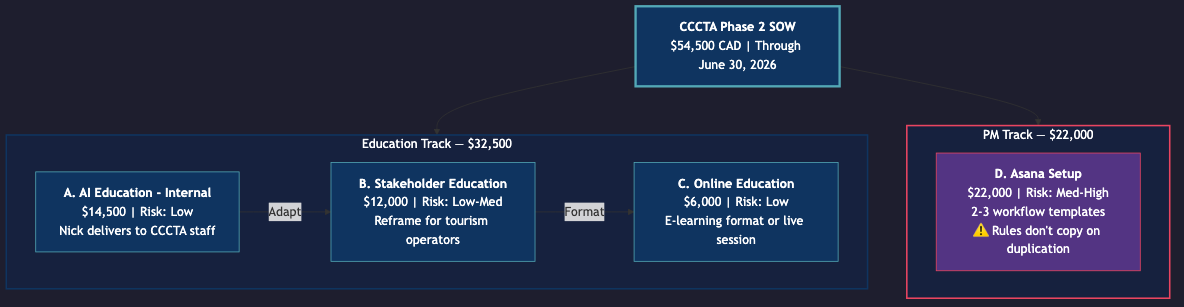
| A. AI Education (internal) | $14,500 | Yes | Low | Adapted from existing curriculum. Nick has delivered this before. |
| B. Stakeholder Education | $12,000 | Yes | Low–Med | Requires understanding tourism operator audience. Quality depends on how well Nick translates for non-technical operators. |
| C. Online Education | $6,000 | Yes | Low | Either format text for e-learning (easy) or deliver one 2-hour session (easy). |
| D. Asana Setup | $22,000 | Yes, with caveats | Med–High | Rules-don't-copy limitation is real. Marra Stewart will need significant hand-holding. |
Overall feasibility: HIGH — but Workstream D needs the template limitation disclosed and the handoff plan beefed up.
Part 3: The Case AGAINST (Steelman)
1. "AI Education Without AI Implementation Is a Tease"
The SOW explicitly excludes AI automation, custom software, data pipelines, and reporting dashboards. Yet Amy Thacker's #1 pain point (from Aug 2025 ops interview):
- Manual quarterly/biannual reporting across 5+ funding programs (takes a full day per report)
- Manual board minutes (18+ meetings/year, 4–5 hours each to write up)
- No automated data pipeline from social/web/finance into reports
- Staff bottleneck tracking (no visibility into who delivered what)
The SOW teaches CCCTA about AI but doesn't give them any. After June 30, they'll know what AI can do but still be doing everything manually.
Why this is fine
This is a contained engagement — not a multi-phase transformation. We have 4 concurrent clients and these guys came in last minute. We were going to charge $100K+ and they turned that down and tried to hire an intern. We are not delivering the $100K option for $20K. Education is appropriately scoped for the budget.
2. "Education Workstreams A/B/C Are One Thing Split Three Ways"
- A ($14,500): AI education for internal team
- B ($12,000): Refine that content for external stakeholders
- C ($6,000): Further refine for e-learning or deliver one live session
This is one curriculum adapted three ways. The marginal effort from A→B is editing/adapting, and B→C is formatting. Combined effort might be 60–80 hours total. At $32,500, that's $400–540/hr.
Counter: Each has distinct audiences, distinct delivery formats, and distinct acceptance criteria. The stakeholder version (B) requires significant reframing for non-technical tourism operators. Nick's live delivery time is expensive and exclusive.
3. "Payment Structure Captures Grant Money, Not Outcomes"
- 30% ($16,350) on execution
- 70% ($38,150) by March 20, 2026
- Work runs through June 30, 2026
- 100% paid 3.5 months before work completes
Counter: This is explicitly driven by REDIP grant invoicing requirements (Section 2.3). CCCTA needs Farpoint to invoice by March 20 to draw down the grant. If Farpoint doesn't invoice, CCCTA loses the funding. The payment timing serves the client's grant compliance. And the SOW term runs through June 30 — Farpoint is still contractually obligated to deliver.
4. "Amy's Real Problems Are Left on the Table"
From the ops interview, Amy's most painful workflows:
- Quarterly/biannual DBC reporting — manual data gathering from 5+ sources
- Board minutes — 18+ meetings/year, 4–5 hours each to transcribe
- Staff accountability tracking — no visibility into who's done what
- Financial planning — manual budget building in spreadsheets
- Travel trade pitch preparation — manual research on journalists/operators
What the SOW addresses: #3 partially (Asana gives task visibility), education (general) What it doesn't: #1, #2, #4, #5
Scope Discipline
Addressing #1 and #2 would require custom software development or AI automation — both explicitly excluded and both would balloon cost and risk. We don't want to deliver $100K of work for $22K. Nick can organically surface quick wins (like meeting transcription) during education delivery and offer them as add-ons if there's appetite.
5. "Is This Digital Transformation?"
A tourism association's "digital transformation" typically includes: CRM strategy, visitor data analytics, operator dashboards, marketing automation, booking integrations, member portals.
This SOW delivers: training + Asana templates.
Counter: CCCTA's starting point is exceptionally low. They had an AI ban. They do USB drive backup rotations. Their CEO manually types board minutes. "Digital transformation" for them starts with foundational literacy and basic project management — not a CRM overhaul. Meeting them where they are is responsible consulting.
Part 4: The Case FOR (Steelman)
1. Correctly scoped for the budget and maturity
CCCTA's digital maturity is early stage:
- Board banned AI until mid-2025
- Staff are afraid to adopt new tools (HubSpot adoption took 18 months)
- Amy is the bottleneck for everything because there's no system
- IT is one external consultant (John)
This is a contained engagement with a client that turned down the full-scope option. Education + PM tooling is the right deliverable at this price point.
2. AI governance work creates organizational value
Phase 1 already delivered an AI governance policy with 6 pillars (Equity, Privacy, Accountability, Transparency, Purposeful Use, Sustainability). This SOW builds on that foundation by training staff to actually use AI within the governance framework.
3. Asana solves Amy's #1 organizational complaint
From the ops interview: "If there is somewhere that I could say, hey, I need this report by such and such a date in a thing and it tells me eight people have done it and I need to poke too, that would be fantastic."
That's literally what Asana does. The PM tool directly addresses the visibility/accountability gap.
4. The grant structure enables the engagement
CCCTA is a ~12-person nonprofit tourism association in rural BC. They don't have $54.5K in discretionary budget. REDIP funding makes this possible. The payment timing is grant compliance, not predatory structure.
5. Scope exclusions protect both parties
By explicitly excluding custom software, integrations, and ongoing admin, the SOW prevents scope creep — the #1 killer of consulting engagements, especially at this price point.
Part 5: Scope Boundary Analysis
Critical: Scope is currently vague and broad
As scoped, the SOW is extremely vague on what's in and out. We need to put strong boundaries on what we will and won't do. The risk is that CCCTA interprets the deliverables expansively and expects $100K+ of work.
What MUST be bounded more tightly
| Area | Current SOW Language | Risk | Recommended Boundary |
|---|---|---|---|
| Education sessions | "AI education for internal team" | Could mean 2 sessions or 20 | Specify exact number of sessions and total hours |
| Stakeholder materials | "Refine for external stakeholders" | Unlimited revision cycles | Cap at X revision rounds, define "done" |
| Asana workflows | "2–3 manual workflows" | "Workflow" is undefined | Define what constitutes one workflow (e.g., one project template with up to X tasks, Y custom fields, Z rules) |
| Handoff | "Brief handoff walkthrough" | Could be 30 minutes or 3 days | Specify number of sessions, duration, attendees |
| Support | Not mentioned | Client may expect ongoing help | Explicitly state: zero post-engagement support unless separately contracted |
What's already well-bounded (keep as-is)
- No custom software development
- No integrations between systems
- No data migration
- No ongoing Asana administration
- No AI tool implementation
- Change order process for out-of-scope requests
Part 6: Complexity Assessment
Is this overcomplicated?
Education (A/B/C): Arguably yes — three workstreams for one curriculum adapted three ways. Could be a single workstream with three deliverable milestones. Splitting them inflates the perception of complexity.
Asana (D): Appropriately scoped. 2–3 workflows is reasonable for the budget.
Is this too simple?
For this engagement, no. This is a scoped, in-and-out engagement — not a digital transformation program. The SOW matches what CCCTA is willing to pay for. Anything more complex and we're doing the $100K option at a fraction of the price.
Could the overall solution be simpler?
Yes. A cleaner structure:
- One education workstream ($24K): AI education for internal team + stakeholder adaptation + e-learning formatting. One price, three milestones.
- One PM setup workstream ($22K): Asana configuration + handoff with honest template language
- Total: $46K with $8.5K margin, or redistribute into stronger deliverables
But consolidation is a stylistic preference, not a requirement. The current structure works if the boundaries are tight.
Part 7: Recommended SOW Changes
Must Fix (before sending)
| # | Issue | Fix |
|---|---|---|
| 1 | Fill in blanks | Effective date, Client CRM name |
| 2 | Fix cross-references | "Section 9" should be "Section 10" for Change Orders |
| 3 | Standardize section numbering | Pick X.0 or X. format consistently |
| 4 | Disclose template limitation | Add language: "Farpoint will provide documentation enabling CCCTA to independently recreate workflow automations in new projects" — frames the limitation positively |
Should Fix (strengthens the SOW)
| # | Issue | Fix |
|---|---|---|
| 5 | Add IP/ownership clause | Who owns the education materials? The Asana configuration? Critical for CCCTA's ability to evolve post-engagement. |
| 6 | Clarify travel booking | Section 6(c) says client arranges travel; Section 8.2 implies Farpoint invoices. Pick one. |
| 7 | Add acceptance criteria | Define what "complete" means for each workstream (e.g., "delivery of X sessions totaling Y hours" for Workstream A) |
| 8 | Add Workstream D milestones | Number of discovery sessions, number of workflows, handoff format |
| 9 | Tighten scope language | Replace vague descriptions with specific deliverable counts, hour caps, and revision limits |
Consider (strategic improvements)
| # | Issue | Fix |
|---|---|---|
| 10 | Consolidate education workstreams | A/B/C into one with three milestones. Simpler, more defensible pricing. |
| 11 | Add measurable outcomes | e.g., "100% staff completion of AI education program", "3 workflows operational in Asana within 30 days of handoff" |
Don't Change
- The scope exclusions are excellent — keep them
- The change order process is clean
- The Addendum B overage rates are reasonable
- The grant alignment rationale in Section 2.3 is well-written
Part 8: Organic Upsell Opportunities
Strategy: Nick surfaces these during education delivery
We aren't going "above and beyond" here — 4 concurrent clients, CCCTA came in last minute. But Nick can organically bring up quick wins while working with them on customizing education material. These become add-on proposals if CCCTA bites.
High-impact, low-effort wins Nick can mention
| Opportunity | Effort to Implement | Annual Impact for CCCTA | Notes |
|---|---|---|---|
| Meeting transcription (Teams/Otter) | ~4 hours setup | ~70–90 hours saved (18 meetings x 4–5 hrs manual minutes) | Already use Teams. Nearly free. |
| AI report drafting (prompt template for DBC reports) | ~6 hours design | Reports go from 1 day → 2–3 hours each | No custom software — just a well-crafted prompt + process |
| Approved AI tool stack | ~4 hours audit | Removes decision paralysis for staff | Maps to the 6 governance pillars from Phase 1 |
These are organic conversation starters during Workstream A/B education delivery — not SOW commitments. If CCCTA wants them implemented, that's a separate, small engagement.
Part 9: Action Items
Immediate (before SOW goes out)
- [ ] Fix the must-fix items — blanks, cross-references, numbering (Items 1–3)
- [ ] Add Asana template disclosure — honest language about rules-don't-copy limitation (Item 4)
- [ ] Tighten scope boundaries — specific deliverable counts, hour caps, revision limits (Item 9)
- [ ] Brief Rabia on Asana limitation — Rules, forms, and task templates do NOT copy when projects are duplicated. She needs to design around this.
Before kickoff
- [ ] Nick to enrich commercial tension section — based on his conversations with CCCTA
- [ ] Add acceptance criteria — what "done" looks like for each workstream (Item 7)
- [ ] Resolve travel clause contradiction — Section 6(c) vs Section 8.2 (Item 6)
Nice to have
- [ ] Add IP/ownership clause (Item 5)
- [ ] Add measurable outcomes (Item 11)
- [ ] Consider consolidating A/B/C into one workstream with milestones (Item 10)
Appendix: Scoring Summary
| Workstream | Deliverability | Impact | Sustainability | Honesty | Overall |
|---|---|---|---|---|---|
| A. AI Education (Internal) | 5 | 3 | 4 | 4 | 4.0 |
| B. Stakeholder Education | 4 | 3 | 3 | 4 | 3.5 |
| C. Online Education | 5 | 2 | 4 | 4 | 3.75 |
| D. Asana Setup | 3 | 4 | 2 | 3 | 3.0 |
| SOW Overall | 3.5/5 |
Bottom line: The SOW is deliverable and commercially defensible at the current price point. The main risks are (1) vague scope language that could lead to expectation mismatch, and (2) the Asana template limitation that could damage credibility if discovered by the client post-handoff. Fix those two issues and this is a solid, contained engagement.